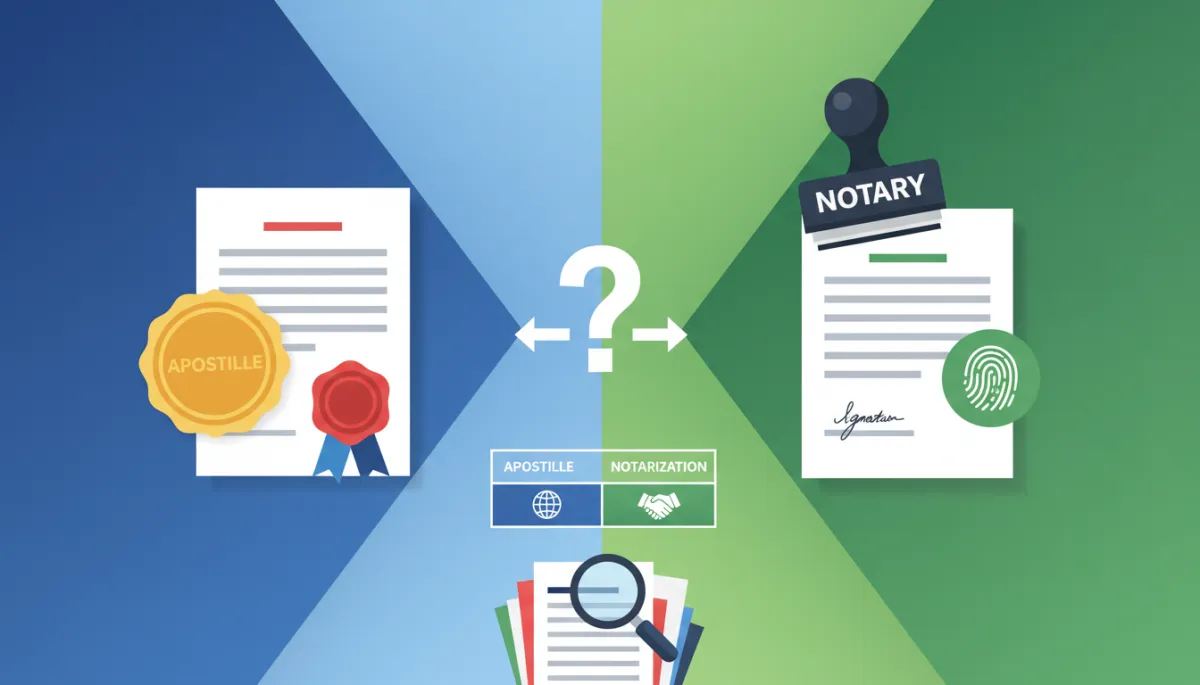
Apostille vs Notarization: Key Differences Explained
Legalization, Apostille vs Notarization, International Documents
Apostille vs. Notarization: What's the Difference?
If you have been told you need an “apostille” or a “notarized document” for use in another country, it is easy to feel overwhelmed. These are technical terms, and most people only encounter them when dealing with important life events like marriage, adoption, immigration, or doing business abroad. This guide explains, in plain language, the difference between an apostille and notarization, what each accomplishes, why you may need both, and how your destination country affects the process.
What Is Notarization?
Notarization is a process performed by a commissioned notary public. The notary’s primary role is to verify identity, confirm that a signer is acting willingly, and, in some cases, that the signer appears to understand what they are signing. The notary then completes a notarial certificate, adds their signature, and affixes an official seal or stamp.
In the United States, notarization is governed by state law. For example, a Florida notary public follows Florida statutes and uses wording and seals that comply with Florida requirements. Seamless Signature Solutions offers professional notary services to help ensure your documents are properly notarized before you take the next step, such as obtaining an apostille or other form of authentication.
What Does Notarization Accomplish?
A notarization does not prove that the contents of a document are true. Instead, it confirms key facts about the signing event, such as:
The person who signed the document appeared in front of the notary.
The signer provided acceptable identification (such as a driver’s license or passport).
The signer acknowledged signing the document or swore/affirmed that statements in the document are true, depending on the type of notarization used.
In short, notarization helps prevent fraud and adds a layer of trust to documents used within the United States. When someone asks if you can use an apostille or notary, it is important to remember that notarization is often the first step, especially for personal and business documents that are not issued directly by a government agency.
What Is an Apostille?
An apostille is a form of international certification used to verify the authenticity of a public document so it can be recognized in another country. It is issued under the Hague Convention of 5 October 1961 Abolishing the Requirement of Legalisation for Foreign Public Documents, often called the “Hague Apostille Convention.”
In the United States, each state issues apostilles for documents that fall under its authority. For example, a Florida apostille is typically issued by the Florida Department of State for documents such as notarized affidavits, corporate documents, or vital records originating in Florida. Seamless Signature Solutions can coordinate apostille processing for Florida and other U.S. states, helping you avoid delays and rejections—especially when your timeline is tight.
What Does an Apostille Accomplish?
While a notary confirms the identity of the signer, an apostille confirms the authenticity of the signature and capacity of the public official who signed the document (such as a notary public, court clerk, or state registrar). It also verifies the authenticity of any seal or stamp on the document. The apostille itself is usually a separate page attached to the document or a stamp with standardized wording recognized by all countries that participate in the Hague Apostille Convention.
When a document with a valid apostille is presented in another member country, the receiving authority can rely on the apostille as proof that the document is official and genuine—without needing further legalization by consulates or embassies. This is why many foreign universities, immigration offices, and courts specifically ask for an “apostilled” document, not just a notarized one.
Notarization verifies a signature; an apostille validates the official who signed.
Apostille vs Notarization: Key Differences at a Glance
When comparing apostille vs notarization, it helps to think of them as serving different levels of validation. Here is an easy-to-understand comparison:
Feature | Notarization | Apostille |
|---|---|---|
Main Purpose | Confirms identity and willingness of the signer. | Confirms authenticity of signature and seal of a public official for international use. |
Where It Is Used | Primarily within the same country or state. | Between countries that are members of the Hague Apostille Convention. |
Who Performs It | A commissioned notary public. | A designated government authority (such as a Secretary of State). |
Typical Documents | Affidavits, powers of attorney, contracts, consent letters. | Notarized documents, vital records, court orders, corporate records. |
Does It Prove Document Content Is True? | No. It only verifies the signing process. | No. It verifies the authenticity of the official’s signature and seal. |
Why You May Need Both a Notarization and an Apostille
Many people assume they must choose between an apostille or notary, but for many documents, the correct answer is both. Here is why:
First, your document is signed and notarized by a notary public (for example, through Seamless Signature Solutions’ notary services).
Then, the notarized document is submitted to the appropriate state authority to obtain an apostille that certifies the notary’s signature and commission.
This two-step process turns your notarized document into a notarized document apostille—a document that has been notarized and then apostilled so it can be accepted abroad. Without the notarization step, many personal and business documents are not eligible for an apostille at all, because the state must be able to verify a recognized public official’s signature or seal.
💡 Practical tip: When in doubt, ask the receiving authority in the destination country exactly what they require. Then, work with a service provider like Seamless Signature Solutions to coordinate both notarization and apostille steps in the correct order.
Common Misconceptions About Apostilles and Notarization
Misconception 1: “A notary can issue an apostille.”
A notary public cannot issue an apostille. The notary’s role is limited to notarizing the document. The apostille is issued by a government authority, such as a Secretary of State’s office or similar agency. Seamless Signature Solutions can connect the dots by providing notary services and managing the apostille application with the appropriate office on your behalf.
Misconception 2: “An apostille makes my document valid everywhere, for any purpose.”
An apostille does not guarantee that a document will meet every legal or administrative requirement in another country. It only confirms the authenticity of the signature and seal. The foreign authority still decides whether the document satisfies their specific rules. For example, a school abroad may require a diploma plus an apostille, plus a certified translation into their language. Always confirm requirements directly with the receiving institution or consult appropriate professionals for guidance.
Misconception 3: “If my document is notarized, I do not need an apostille.”
Notarization alone is usually not enough for documents that will be presented abroad. A foreign government or institution may not be familiar with U.S. notary seals or state formats. The apostille bridges this gap, telling the foreign authority, “Yes, this notary or official is legitimate, and the signature and seal are authentic.”
Misconception 4: “All countries accept apostilles.”
Apostilles are recognized only by countries that are members of the Hague Apostille Convention. If the destination country is not a member, your document may need a different type of legalization, often involving multiple steps with the state, federal, and consular authorities. Seamless Signature Solutions can help you understand whether an apostille is appropriate or whether another process is required based on the country involved.
Examples of Documents Commonly Used Internationally
Many life events and business activities require documents to cross borders. Here are some examples of documents that often require notarization, an apostille, or both before they can be used in another country:
Birth, marriage, and death certificates – Frequently needed for immigration, dual citizenship, marriage abroad, or inheritance matters. These may be certified by a vital records office and then apostilled by the state where they were issued (for example, a Florida birth certificate receiving a Florida apostille).
Diplomas, transcripts, and education records – Required for studying abroad, professional licensing, or employment in another country. Schools may issue certified copies, which are then notarized and apostilled.
Power of attorney and affidavits – Used when you need someone to act on your behalf in another country, or when you must make a sworn statement for a foreign court or agency. These documents are usually notarized first, then apostilled for international acceptance.
Corporate documents – Such as articles of incorporation, certificates of good standing, board resolutions, or commercial contracts used to open foreign bank accounts, register a branch, or bid on international projects. These may be certified by a state agency or notarized and then apostilled.
Adoption and guardianship documents – Often require careful handling, multiple certifications, and sometimes additional consular steps, depending on the countries involved.
Why the Destination Country Matters
When deciding between an apostille vs notarization, the destination country is one of the most important factors. Requirements can change significantly based on whether the country is a member of the Hague Apostille Convention and what type of authority is requesting the document.
If the Country Is a Hague Apostille Member
If the receiving country is a member of the Hague Apostille Convention, an apostille is typically the recognized method of authenticating U.S. documents. For example, if you are sending a notarized power of attorney from Florida to Spain, you would usually:
Have the power of attorney notarized in Florida (Seamless Signature Solutions can assist).
Obtain a Florida apostille from the Florida Department of State to authenticate the notary’s signature.
Once apostilled, the document can generally be used in Spain without any further legalization steps, provided it meets Spain’s specific content and translation requirements.
If the Country Is Not a Hague Apostille Member
If the destination country is not part of the Hague Apostille Convention, the process is different. The document may require:
Notarization by a U.S. notary public.
Certification by a state authority (similar to an apostille but not called an apostille).
Authentication by the U.S. Department of State.
Legalization by the embassy or consulate of the destination country.
Because these steps vary by country and can change over time, it is important to confirm the current process and timelines. Seamless Signature Solutions can help you determine whether an apostille is appropriate or whether a different legalization route is required—without providing legal advice or replacing guidance from qualified professionals.
How Seamless Signature Solutions Can Help
Navigating apostilles and notarizations on your own can be time-consuming and confusing. Missing a small detail—such as using the wrong type of notarization or submitting a document to the wrong office—can lead to rejections and costly delays. Seamless Signature Solutions offers:
Professional notary services – Including guidance on properly preparing documents for notarization so they can qualify for an apostille or other authentication later.
Apostille coordination – Managing submissions to the correct state authority (such as for a Florida apostille) and tracking processing so you can focus on your plans instead of paperwork.
Clear communication – Explaining, in everyday language, what steps are needed for your specific situation, while encouraging you to verify requirements with the receiving authority and seek legal advice when appropriate.
📌 Key takeaway: You do not have to become an expert in apostille rules or state notary laws. Partnering with a dedicated service provider helps you avoid errors and keeps your international plans moving forward.
FAQs: Apostille vs Notarization
1. What is an apostille in simple terms?
An apostille is a special certificate issued by a government authority that confirms a public official’s signature and seal on a document so that it can be recognized in another country that is part of the Hague Apostille Convention. It does not confirm that the content of the document is true; it simply tells the foreign country that the signature and seal on the document are genuine and official.
2. Do I need an apostille or a notary for my document?
It depends on two main things: the type of document and the country where it will be used. Many documents require both notarization and an apostille—first the notary verifies your signature, then the state issues an apostille to authenticate the notary’s signature. Some government-issued records may not require notarization but still need an apostille. Because requirements vary, it is wise to confirm with the receiving authority and then work with a service like Seamless Signature Solutions to complete the necessary steps accurately.
3. Can I get a Florida apostille on any document?
A Florida apostille can be issued only for documents that fall under Florida’s jurisdiction—such as vital records issued in Florida, court documents from Florida courts, or documents notarized by a Florida notary public. If your document was issued in another state, it usually must be apostilled in that state instead. Seamless Signature Solutions can help you determine whether your document qualifies for a Florida apostille or if it needs to be processed elsewhere.
4. How long does it take to get an apostille?
Processing times vary by state, time of year, and whether you choose standard or expedited service. Some states can issue an apostille within a few business days, while others may take several weeks. Additional time may be needed for shipping, translations, or consular steps if the destination country is not part of the Hague Apostille Convention. Seamless Signature Solutions can provide current estimates and help you plan your timeline accordingly.
5. Does this information replace legal advice?
No. This article is for general informational purposes only and is not intended as legal advice. Requirements for apostilles, notarizations, and document acceptance can change and may depend on your specific situation. You should consult appropriate legal or professional advisors if you have questions about your rights, obligations, or the legal impact of your documents.
Next Steps: Get Help Choosing the Right Service
Understanding the difference between apostille vs notarization is the first step toward getting your documents accepted abroad. The next step is making sure each document is prepared, notarized, and authenticated in the correct order for the country and institution that will receive it. Seamless Signature Solutions offers convenient notary services and coordinated apostille processing to help you move through this process with confidence.
If you are unsure whether you need a simple notarization, a notarized document apostille, or another type of legalization, you do not have to figure it out alone. Contact Seamless Signature Solutions to discuss your situation, verify what services we can provide, and get clear, practical guidance on the next steps—without legal advice.
Ready to move forward? Request assistance today to help determine the appropriate service for your documents and call 866-977-5774 to speak with Seamless Signature Solutions about your apostille and notary needs.