
Florida Remote Notary for Overseas Clients
Remote Online Notary, International Notarization, Apostille
Can a Florida Remote Online Notary Help Someone Who Is Overseas?
If you are living, traveling, or working abroad and suddenly need a U.S. document notarized, a Florida remote online notary can often be a convenient solution. However, international situations add extra layers of rules, technology, and receiving‑country requirements that you should understand before you schedule your session. This guide walks you through how a Florida online notary can help someone overseas, what may be different in international cases, and why confirming acceptance with the receiving party is absolutely essential.
How Florida Remote Online Notarization Works When You Are Overseas
Florida law allows a Florida remote online notary to notarize documents for signers who are located almost anywhere in the world, as long as the notary is physically in Florida at the time of the session and uses approved audio–video technology. The principal (you) and any witnesses can be outside the state—or even outside the United States—while the notarization is performed under Florida law.
In other words, an online notary overseas session usually means: you are abroad, but your notary is commissioned in Florida and remains in Florida while meeting with you online. The notarization is considered a Florida notarial act, even though you are physically in another country. This flexibility can be extremely helpful for U.S. real estate transactions, estate planning documents, financial powers of attorney, and other paperwork that cannot wait until you return home.
1. Identity Verification for International Remote Notary Sessions
Identity verification is one of the biggest differences when a Florida online notary international appointment involves a signer outside the United States. Florida statutes require strict identity proofing and credential analysis for remote online notarization, and the Department of State sets minimum standards for how this must occur. These safeguards are designed to protect you, the notary, and any receiving institutions from fraud or impersonation.
Government‑issued ID: You will typically present a valid passport, driver’s license, or other government photo ID to the camera, and the RON platform will capture and analyze it electronically to confirm authenticity.
Credential analysis: The RON system uses automated checks to confirm that your ID is genuine and unaltered—looking at security features, expiration dates, and data consistency.
Knowledge‑based authentication (KBA): Florida law requires a series of timed, multiple‑choice questions drawn from trusted data sources. You may be asked about past addresses, vehicles you have owned, or other personal history details that only you should know.
For signers who do not have a U.S. credit history, or who are using only foreign identification, passing KBA can sometimes be challenging. Rulemaking is also underway to consider biometric verification options, such as facial recognition, as an additional tool for identity proofing. Because of these evolving standards, not every overseas signer will qualify for every RON platform. A reputable international remote notary service will review your situation in advance and let you know which forms of ID may be acceptable, without promising universal eligibility.
💡 Pro Tip: Before scheduling your session, confirm that your ID is current, legible, and matches the name that appears on your document to avoid delays or failed identity checks.
2. Why the Document’s Destination Country Matters
The next key question is: Where will the notarized document be used? The rules for a U.S. document that stays in the United States are very different from the rules for a document that will be sent to a foreign government office, university, or court. When you use a Florida remote online notary for a document that will cross borders, you must think about the document’s destination from the very beginning.
Hague Apostille Convention countries: If the document will be used in a country that is part of the 1961 Hague Convention, the usual pathway is notarization, followed by an apostille from the appropriate U.S. authority. The apostille confirms the authenticity of the notary’s commission so that the foreign country can recognize the document without further legalization.
Non‑Hague countries: If the destination country is not a member of the Hague Convention, the document usually requires a different form of authentication or consular legalization. This may involve multiple steps at the state, federal, and foreign consulate levels.
In both cases, a Florida online notarization is often just the first step. A notarial seal alone is frequently not enough for international use; the document may still need to move through the apostille or authentication process before a foreign authority will accept it. For that reason, many clients find it helpful to coordinate their remote online notary appointment with a service that also assists with apostille and authentication, so everything is aligned with the destination country’s rules.
3. Receiving‑Party Requirements: The Most Important Voice in the Process
Even when Florida law clearly allows a particular type of notarization, the receiving party—the bank, school, employer, court, or government agency that will ultimately review your document—may have its own policies. These policies can be stricter than the law and can differ from one institution to the next, especially across borders. This is why using an online notary overseas should always be paired with direct confirmation from the organization that requested your document.
Some foreign agencies readily accept Florida online notary international documents, especially for business or financial matters, as long as the documents later receive an apostille or authentication.
Others may insist on a traditional ink‑signed notarization, or even a notarial act performed in person at a U.S. embassy or consulate, regardless of what Florida law allows for RON.
Some institutions outside the U.S. are still unfamiliar with remote online notarization and may treat it differently from traditional notarization, even though Florida considers both valid.
📌 Key Takeaway: The receiving party has the final say on what they will accept. Always ask them whether a Florida remote online notarization, followed by apostille or authentication if needed, meets their requirements.
4. Technology Considerations When You Are Outside the United States
Technology is at the heart of every international remote notary session. Florida’s RON laws require secure, two‑way audio–video communication that allows the notary to clearly see and hear you, verify your identity, and record the entire session. When you are overseas, a few additional technology questions come into play.
Internet quality: You need a stable, high‑speed internet connection that supports streaming video without frequent drops. If your connection fails repeatedly, the notary may not be able to complete the session or the recording required by Florida law.
Device compatibility: Most RON platforms work on modern computers, tablets, and smartphones, but some features—like ID scanning or digital signing—may function best on certain devices or browsers. Testing your setup in advance can save time.
Local restrictions: A few countries restrict or monitor certain kinds of video calling or encryption technologies. While many signers never encounter issues, it is wise to be aware of any local limits that could affect your ability to connect to a secure RON platform.
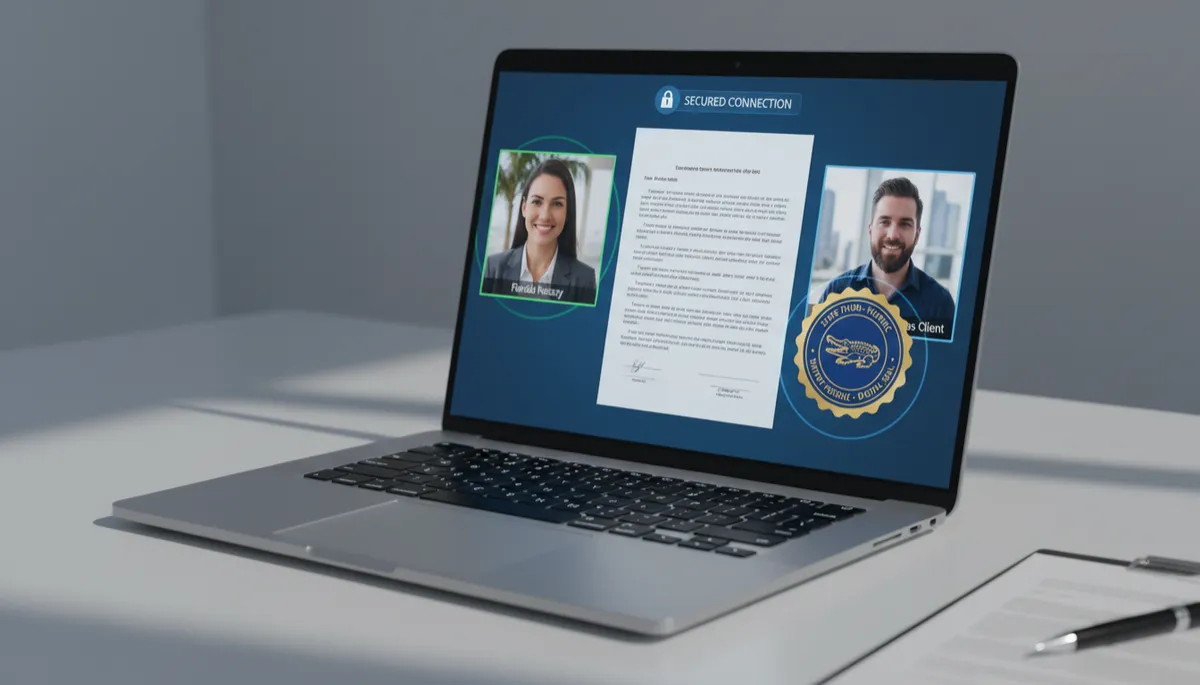
Reliable audio–video technology is essential for a valid Florida remote online notarization.
Florida requires that the RON provider maintain tamper‑evident electronic records and store the session recording in a secure repository. That means your online notary overseas experience is not just a casual video chat; it is a carefully controlled legal procedure that depends on technology meeting specific standards for security and clarity.
5. Apostille and Authentication After Your Online Notarization
Once your document has been notarized by a Florida remote online notary, the next question is whether it needs an apostille or authentication certificate for international use. This step does not happen automatically. It is a separate process that depends on the type of document and the country where it will be used.
Apostille for Hague Convention Countries
If your document is destined for a Hague Convention country, the typical sequence is:
Complete your Florida online notary international session and receive the notarized electronic document.
Submit the notarized document to the appropriate Florida authority (often the Florida Department of State) or a professional apostille service that can handle the filing on your behalf.
Receive the apostille, which verifies the authenticity of the notary’s commission so the foreign country can recognize the document.
Many clients appreciate working with a provider that offers both remote online notarization and apostille services, because the steps can be coordinated in a way that meets the receiving country’s rules. For example, some destinations may prefer a printed, ink‑signed version of your electronically notarized document before the apostille is attached, while others accept fully electronic workflows. Internal coordination between RON and apostille support can help align the process to those expectations.
Authentication and Consular Legalization for Non‑Hague Countries
For non‑Hague countries, the path is often longer. After a Florida online notarization, the document may need:
Authentication by the Florida Department of State or another state authority, and then
Legalization by the foreign country’s consulate or embassy in the United States.
The exact steps vary by country and document type. Because of these variations, it is helpful to discuss your apostille or authentication needs at the same time you arrange your RON session. Internal links between remote online notary support and apostille/authentication services make it easier to design a complete plan from notarization through final legalization, rather than treating each step in isolation.
6. Why You Should Always Confirm Document Acceptance in Advance
No matter how carefully your Florida remote online notarization and apostille or authentication are handled, only the receiving party can decide whether your documents meet their internal standards. Different countries—and even different offices within the same country—may follow different practices. For that reason, it is important to think of your notary and apostille providers as part of a larger team that also includes the institution requesting your documents.
Ask specific questions: Instead of asking “Is a notarized document okay?”, ask whether they accept Florida remote online notarization for your type of document and whether they require an apostille or authentication on top of the notary seal.
Clarify format: Some recipients insist on an original paper document with wet signatures and raised seals; others may accept electronically signed and notarized PDFs. Knowing this in advance can save you from having to repeat the entire process.
Confirm timing: Apostille and authentication steps can take additional days or weeks. If you have a filing deadline, make sure the overall timeline—from RON session to final submission—fits the receiving party’s schedule.
⚠️ Important: A professional Florida remote online notary or apostille service can explain general requirements, but they cannot guarantee that a foreign government, school, or bank will accept a particular document. Only that institution can provide final confirmation.
Florida Remote Online Notary vs. Consular Notary When You Are Abroad
When you are outside the United States, you often have more than one way to notarize a U.S. document. A Florida remote online notary is one option. Another common path is to visit a U.S. embassy or consulate and use their in‑person notarial services. Each choice has advantages and limitations, and the best option depends on the receiving party’s expectations and your own circumstances.
Florida remote online notary: Convenient, often faster, and can be completed from your home or office overseas. Works especially well when the document will ultimately be used in the United States or in a Hague Convention country that accepts RON‑notarized documents with apostille.
U.S. embassy or consulate notarization: Requires an in‑person visit, scheduling, and travel, but some foreign authorities are more familiar with consular notarizations and may prefer them in certain situations.
Before choosing between these paths, contact the institution that will receive your document and ask which type of notarization they prefer. If they confirm that a Florida international remote notary session is acceptable, you can often save significant time and travel by handling everything online and then moving directly into any needed apostille or authentication steps.
Frequently Asked Questions About Florida Online Notary for Clients Overseas
Can I notarize a document from overseas using a Florida remote online notary?
In many cases, yes. Florida allows a commissioned online notary to perform notarial acts for signers who are physically outside the state—even outside the United States—as long as the notary is in Florida and uses approved audio–video technology. Eligibility can still depend on factors like your identification, your location, and any platform‑specific rules, so it is important to discuss your situation with the notary service beforehand.
Will my foreign bank, school, or government office accept a Florida online notarization?
Acceptance policies vary widely. Some institutions accept Florida remote online notarizations, especially when combined with an apostille or authentication, while others prefer traditional notarizations or consular services. Because of this variation, a notary service cannot promise that every foreign institution will accept every document. The safest approach is to contact the receiving party directly and ask whether a Florida RON‑notarized document meets their requirements and whether it also needs an apostille or authentication certificate.
Do I still need an apostille if my document is notarized online?
If your document will be used in another country, it often does. Remote online notarization and apostille serve different purposes. The RON session verifies your signature under Florida law; the apostille or authentication verifies the authority of the notary’s commission for international use. If the destination country is part of the Hague Apostille Convention, an apostille from the appropriate U.S. authority is usually required. For non‑Hague countries, an authentication certificate and consular legalization may be necessary instead.
Can a Florida remote online notary help with both notarization and apostille?
Many providers offer connected services, where the same team that schedules your international remote notary session also coordinates apostille or authentication afterward. This internal link between RON and apostille support can simplify your experience and help ensure the steps are taken in the correct order. When you reach out, mention both your notarization and apostille needs so your provider can suggest an end‑to‑end plan that considers your destination country and deadline.
What if my internet connection is poor while I am overseas?
A stable connection is essential for a valid RON session because Florida law requires clear audio–video communication and a complete recording of the notarization. If your connection drops repeatedly or the video is too blurry for the notary to verify your identity, the session may need to be rescheduled. Whenever possible, use a wired or high‑quality Wi‑Fi connection, close other apps that use bandwidth, and test your camera and microphone before your appointment.
Are all types of documents eligible for Florida online notarization from overseas?
Florida online notaries can perform most of the same notarial acts they would handle in person, with a few statutory exceptions. However, individual notaries and RON platforms may set their own restrictions on document types, and foreign institutions may have their own preferences. Always describe your document in detail when you contact the notary service and confirm with the receiving party that your chosen method of notarization is appropriate for that specific document and purpose.
Bringing It All Together: Plan Your International Notarization from Start to Finish
A Florida remote online notary can be a powerful resource when you are overseas and need documents notarized under U.S. law. At the same time, international use adds extra steps and questions that do not appear in purely domestic transactions. Identity verification standards, the document’s destination, receiving‑party preferences, technology requirements, and apostille or authentication procedures all play a role in whether your paperwork will ultimately be accepted.
The most successful international notarizations share three things in common:
A clear understanding of how Florida RON works, including identity proofing and technology standards.
Early coordination between the online notary overseas session and any required apostille or authentication steps, so the process is designed around the destination country’s rules.
Direct confirmation from the receiving party that your chosen method—Florida remote online notarization plus any follow‑up legalization—matches their expectations.
When these elements are in place, a Florida online notary can often help you complete essential paperwork quickly and efficiently, even when you are thousands of miles away. To discuss your specific document, destination country, and timeline—and to explore how remote online notarization and apostille or authentication services can work together for your situation—call 866-977-5774.