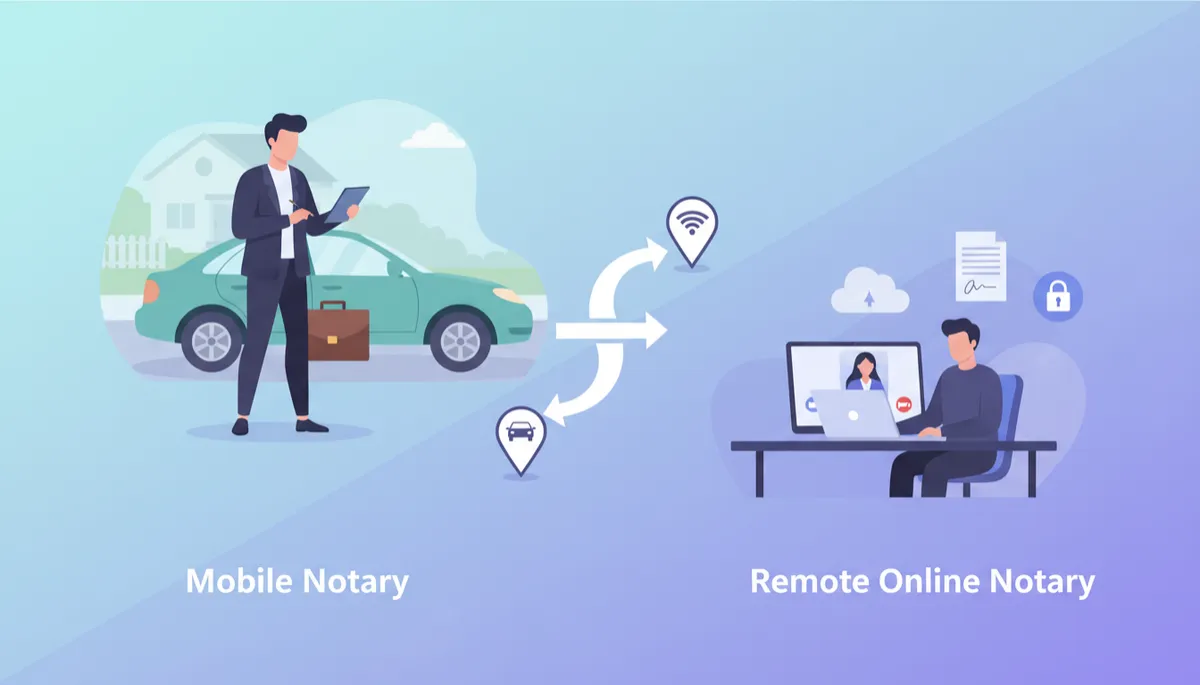
Mobile vs. Online Notary: Choose the Right Service
Notary Services, mobile notary vs online notary, remote notary vs mobile notary, online notary Florida, mobile notary Florida
Mobile Notary vs. Remote Online Notary: Which Option Fits Your Situation?
When you need a document notarized, you now have more choices than ever. Two of the most popular options are a mobile notary, who travels to meet you in person, and a remote online notary (RON), who notarizes your documents over a secure video call. Both are legal and widely accepted in Florida, but they work very differently. Understanding those differences will help you choose the option that truly fits your situation, timeline, and comfort level.
Mobile Notary vs. Remote Online Notary: A Quick Overview
Before diving into details, it helps to define each service:
Mobile Notary: A commissioned notary who travels to your home, office, hospital, or another agreed-upon location to notarize documents in person. This is sometimes called a traveling notary or mobile notary public. In Florida, this is a traditional in-person notarization with the added convenience of on-site service.
Remote Online Notary (RON): A Florida notary who is specially authorized to perform notarizations online using audio-video technology. You and the notary connect through a secure platform, verify your identity electronically, and sign digital versions of your documents.
Both options can be arranged through professional providers like SSS Mobile Notary Florida services and SSS Remote Online Notary Florida services. The right choice depends on your specific needs, which we’ll explore in detail below.
Side-by-Side Comparison: Mobile Notary vs Online Notary
Factor | Mobile Notary (In-Person) | Remote Online Notary (RON) |
|---|---|---|
Convenience | Notary travels to you; ideal if you prefer face-to-face help or have limited tech access. | Meet from anywhere with internet; no travel time; often faster for simple documents. |
Physical Presence | All signers and the notary are in the same room, signing paper documents. | Presence is virtual via live video; documents are digital and signed electronically. |
Technology Requirements | Minimal tech needed; helpful for seniors or clients uncomfortable online. | Requires computer or smartphone, camera, microphone, and stable internet connection. |
Document Type & Format | Paper documents; wet ink signatures; ideal for documents that must remain physical. | Electronic documents; digital signatures; best when recipients accept e-notarization. |
Location Rules | Notary must be physically in Florida with you; travel radius may apply. | Notary is in Florida; signers can often be out of state or even abroad, subject to law and document requirements. |
Identification | Physical government-issued ID shown in person; notary visually inspects it. | Online ID verification and knowledge-based questions plus visual ID check via camera. |
Scheduling | Appointment windows based on travel time; great for planned signings or multiple signers together. | Flexible and often same-day; no travel means more time slots and after-hours options. |
Common Use Cases | Real estate closings, hospital or nursing home signings, estate planning, and situations requiring handholding. | Routine affidavits, business forms, remote employees, and signers in different locations. |

Remote online notarization lets Florida signers complete documents securely without leaving home.
1. Convenience: How Do the Experiences Compare?
When comparing mobile notary vs online notary, convenience is usually the first thing people think about. Both options are designed to make notarization easier than driving to a traditional office, but they do it in different ways.
With a mobile notary Florida service, the notary comes to you. This is ideal if you have mobility challenges, are caring for children or elderly family members, or simply prefer someone to handle the paperwork in person. You do not have to print, scan, or upload documents yourself if you arrange this in advance with your provider.
With an online notary Florida service, you can usually schedule a session quickly and connect from your home, office, or even while traveling. There is no commute, no waiting room, and no need to coordinate everyone in one physical place.
If you are tech-comfortable and your document recipients accept electronic notarization, remote online notary may feel more convenient. If you prefer paper, face-to-face interaction, or hands-on help, a mobile notary may be the more comfortable choice. Neither is universally better; it depends on what “convenient” means to you.
2. Physical Presence: In-Person vs. Virtual Meetings
A key difference in the remote notary vs mobile notary debate is physical presence. Traditional notarization laws were built around everyone being in the same room. Florida law now allows secure online notarization, but some people and institutions still prefer in-person meetings for certain documents.
Mobile Notary: The notary, signers, and any required witnesses meet at the same location. The notary can observe body language, verify that everyone appears willing and aware, and see the documents being signed in real time on paper. This can be reassuring in sensitive situations like elder care or estate planning.
Remote Online Notary: Physical presence is replaced by a live audio-video session. The notary still observes you sign, but through your camera. Florida requires that the session be recorded and stored for a set period, adding a layer of accountability and security.
If you feel more comfortable with a notary physically present—especially for emotional or complex signings—a mobile notary may suit you better. If you are used to video meetings and value speed, remote online notarization can be just as valid and secure, while saving time.
3. Technology Requirements: What Do You Need to Use Each Service?
Technology is where the difference between mobile notary and online notary becomes very clear. Your comfort with devices and internet access can strongly influence which option fits you best.
Mobile Notary: Low-Tech, High-Touch
For a mobile notary appointment, you typically only need:
Your printed documents (unless your provider brings them)
Valid identification
A place to sit and sign
This can be ideal for seniors, clients without reliable internet, or anyone who finds scanning and uploading documents stressful. The notary handles the technical side of the notarization process for you.
Remote Online Notary: Digital Tools Required
To use an online notary Florida service, you generally need:
A computer, tablet, or smartphone with camera and microphone
Reliable, high-speed internet connection
Ability to upload or access your documents in digital format (PDF is common)
A smartphone or device to complete identity verification steps, such as texted codes or knowledge-based questions
If you already work online and are comfortable with video calls and digital signatures, these requirements may feel very manageable. If not, a mobile notary may be more comfortable and less stressful.
4. Document Considerations: Paper vs. Digital and Acceptance Rules
Not every document is treated the same way. Before you decide between mobile notary vs online notary, consider what kind of document you have and who will receive it. Some organizations still require “wet” ink signatures and physical seals, while others readily accept electronically signed and notarized documents.
When Mobile Notary May Be Better for Your Documents
Original paper documents that must be physically mailed or recorded, such as certain deeds or court filings, may be easier to handle in person. The notary can stamp directly on the document and return the originals to you immediately.
If your recipient is unfamiliar with remote online notarization or explicitly asks for a traditional notarization, a mobile notary ensures there are no questions about acceptance.
When Remote Online Notary May Fit Your Documents
Many financial institutions, employers, and government agencies now accept electronically notarized documents, especially for forms, affidavits, and routine authorizations. Remote online notary can speed up the process when documents will be stored or transmitted digitally anyway.
If you are coordinating signers in different locations, digital documents make it easier to gather all signatures without shipping paper back and forth.
💡 Pro Tip: Before scheduling, ask the receiving party—such as a lender, title company, or court—whether they accept remote online notarization. This quick step can prevent delays and help you choose the right type of notary service from the start.
5. Location: Where Are You and Your Signers?
Location impacts both mobile and online notarization, but in different ways. Florida law requires that the notary be physically located in Florida at the time of notarization, whether it is in person or online. However, the rules for where signers can be are more flexible with remote online notary.
Mobile Notary Florida: Local, On-Site Service
With a mobile notary, everyone must be in the same physical place within the notary’s travel area. This is perfect if:
All signers are in the same city or region of Florida
The signing is happening at a hospital, nursing home, office, or home
Remote Online Notary: Flexibility Across Distances
For remote online notary, the notary is in Florida, but signers can often be:
Elsewhere in Florida
In another U.S. state
Sometimes even outside the country, depending on local laws and the document type
This flexibility is a major advantage when family members live in different states, when you are traveling, or when you are working with remote employees or clients. If everyone is local and prefers to gather in one place, a mobile notary can offer a more personal experience.
6. Identification: How Your Identity Is Verified
Proper identification is essential for any notarization. Both mobile and remote online notaries must follow Florida’s strict rules, but the methods they use differ because of the environment—physical vs. virtual.
ID for Mobile Notary Appointments
For a mobile notary visit, you typically present a government-issued photo ID such as:
Florida driver’s license or ID card
U.S. passport
Other approved government-issued IDs
The notary inspects your ID in person, compares your appearance, and may ask a few basic questions to confirm your identity and willingness to sign.
ID for Remote Online Notary Sessions
Online notarization adds extra layers of identity proofing. In addition to showing your ID on camera, you may be asked to:
Answer knowledge-based questions about your credit or address history (similar to questions asked by credit bureaus)
Upload an image of your ID for automated verification
These tools help ensure that the person on the video call is truly the person named on the document. If you are comfortable answering security questions and following on-screen prompts, remote online notary can be straightforward. If you prefer a simpler, face-to-face ID check, a mobile notary may feel more natural.
7. Scheduling: Timing, Availability, and Urgent Needs
Both mobile and online notaries are designed to be more flexible than a traditional walk-in office, but they handle scheduling in different ways.
Scheduling a Mobile Notary Florida Visit
Mobile notaries build travel time into their calendars. That means:
You choose a time window for the notary to arrive at your location
Appointments may need to be set slightly further in advance, especially for peak times or multiple signers
This approach works well for planned events like real estate closings, will signings, or scheduled hospital visits, where everyone can commit to a specific time and place.
Scheduling a Remote Online Notary Session
Because there is no travel, online notaries can often offer:
Same-day or next-day appointments
Evening or weekend availability for busy professionals
Shorter appointment windows, since there is no drive time or parking
If your schedule is tight and your documents are suitable for online notarization, choosing an online notary Florida service can help you get everything done quickly without rearranging your entire day.
8. Common Use Cases: When Each Option Tends to Work Best
While there are always exceptions, certain patterns have emerged in how people use mobile notary vs online notary services in Florida. Looking at typical scenarios can help you decide which option aligns with your own situation.
Situations That Often Favor a Mobile Notary
Real estate closings: Buyers, sellers, and agents may prefer to sit together, review documents, and sign everything in one coordinated visit.
Hospital or nursing home signings: When a patient or resident cannot travel, a mobile notary can come to the facility and work with staff and family members on-site.
Estate planning documents: Wills, trusts, and powers of attorney are often signed in person for added peace of mind, especially when older signers or multiple witnesses are involved.
Situations That Often Favor a Remote Online Notary
Routine forms and affidavits: Many everyday documents, such as employer forms, travel consent letters, or simple affidavits, can be handled quickly online, especially when time is limited.
Remote workers and business clients: Companies with employees or clients spread across states often find it easier to use remote online notaries so everyone can sign without travel.
Travelers or out-of-state signers: If you are temporarily outside Florida but need a Florida notary, remote online notarization may be an option, subject to the requirements of your document.
Again, there is no single “best” option. The question is which service fits your specific combination of document type, location, comfort level, and deadline.
How to Decide: Questions to Ask Yourself
To choose between mobile notary vs online notary, it can help to walk through a few simple questions:
Does the receiving party accept remote online notarization? If not, a mobile notary is the safer option.
Are all signers in the same place? If yes, and they prefer in-person help, a mobile notary may feel more natural. If signers are scattered, online notarization may be easier.
How comfortable are you with technology? If video calls and digital signatures are second nature, remote online notary is a strong option. If not, consider mobile notary.
Do you need a wet ink signature on paper? If your document must remain physical, a mobile notary is often the better fit.
What is your timeline? If you need something notarized quickly and digitally, an online notary Florida provider can often schedule sooner, especially after hours.
If you are still unsure, you do not have to decide alone. A professional notary service can review your situation and recommend either a mobile notary Florida visit or a remote online notary session, based on your documents and preferences.
Frequently Asked Questions About Mobile and Online Notaries in Florida
1. Is a remote online notary as legal as a mobile notary in Florida?
Yes. Florida law specifically authorizes remote online notarization when it is performed by a properly commissioned online notary using approved technology. The notarization is just as legally valid as an in-person notarization by a mobile notary, as long as all requirements are met. The main question is whether your particular recipient accepts electronically notarized documents, which you should confirm in advance.
2. Which is faster: mobile notary or online notary?
For many simple documents, a remote online notary can be faster because there is no travel time and appointments are often available on short notice. However, if your documents are already printed and everyone is in one place, a mobile notary may be just as efficient—especially when you schedule a single visit to handle a large set of documents at once. Speed often depends on your readiness and the provider’s availability more than the type of service itself.
3. Can I switch from online notarization to mobile notarization if my documents are rejected?
If a recipient unexpectedly refuses an electronically notarized document, you may need to have the document re-notarized in person with a mobile notary. To avoid this, always ask the receiving institution whether they accept remote online notarization before you schedule. A professional provider can also help you confirm typical acceptance for your type of document based on experience.
4. What if one signer is in Florida and another is out of state?
This is where remote online notarization can shine. As long as the notary is located in Florida and the document type allows it, signers in different locations can often join the same online session or separate sessions to complete the notarization. If all signers must appear together in person for legal or practical reasons, then a mobile notary may still be the better choice, but many multi-location signings can be handled online.
5. How do I choose the right notary service provider in Florida?
Look for a provider that offers both mobile notary Florida services and online notary Florida services, so you are not locked into one option. Ask about their experience with your type of document, their availability, and whether they can guide you on acceptance requirements. A reputable service will focus on matching you with the right solution—whether that is a mobile visit, a remote online session, or a combination of both for different documents.
Next Steps: Talk Through Your Situation with a Notary Professional
Choosing between mobile notary vs online notary does not have to be confusing. Start by considering your convenience, comfort with technology, document requirements, and where your signers are located. Then, confirm what the receiving party will accept. From there, a knowledgeable notary service can help you finalize the best approach and handle the details for you.
If you are in Florida and need guidance, explore SSS mobile notary services for in-person visits and SSS online notary services for secure remote notarization. You do not have to decide alone which option fits best.
To talk through your documents, timeline, and location and get a recommendation tailored to your situation, call 866-977-5774 today. A notary professional can help you choose the right service—mobile or remote online—and get your notarization completed smoothly and on time.