Understanding Different Methods of Notarization
Understanding Different Methods of Notarization
With the evolution of technology, Notaries now have multiple ways to perform their duties. From traditional in-person appointments to secure online signings, each method offers unique benefits and complies with varying state laws. Let’s explore the five main notarization formats and what makes each one distinct.
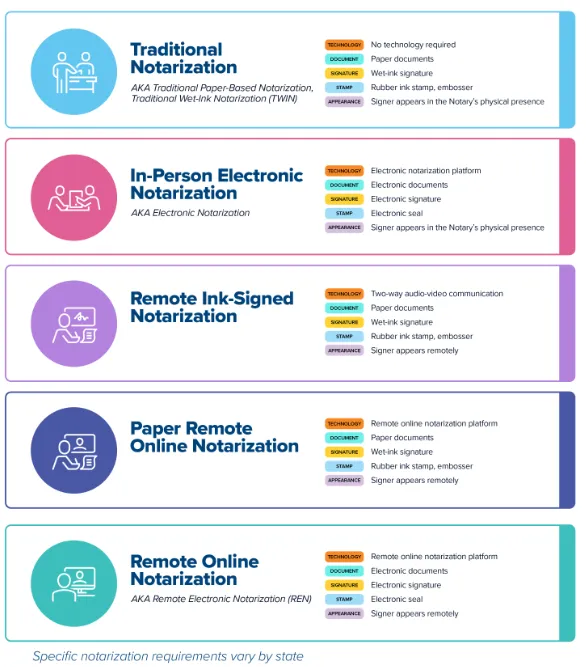
🖊 1. Traditional Wet-Ink Notarization (TWIN)
This is the classic method where the signer and Notary meet in person. All signatures and the Notary’s seal are completed in ink on physical paper.
💻 2. In-Person Electronic Notarization (IPEN)
Here, the Notary and signer are physically present, but signatures are applied electronically—typically on a tablet or computer. The seal is also electronic.
📹 3. Remote Ink-Signed Notarization (RIN)
Conducted over a secure video call, the Notary watches as the signer physically signs the document. The signer then mails it to the Notary, who completes and seals it before sending it back.
🧾 4. Paper Remote Online Notarization (PRON)
Similar to RIN, this method also involves a video session and requires identity verification using multi-factor authentication. The document is signed in ink and mailed between the signer and Notary.
🌐 5. Remote Online Notarization (RON)
Entirely digital and conducted online, RON uses secure audio-video platforms and multi-step ID verification. Both the signer and Notary apply electronic signatures and seals on digital documents.

📄 Document Formats
TWIN, RIN, PRON: Use physical documents signed in ink.
IPEN, RON: Use digital files like PDFs, signed and sealed electronically.
🪪 Signer Identification
All methods require ID verification:
In-person (TWIN/IPEN): Personal knowledge, valid ID, or a credible witness.
Remote (RIN/PRON/RON): May include ID upload, credential analysis, knowledge-based questions, or biometric validation—depending on state law.
✍️ Seal & Signature Requirements
TWIN, RIN, PRON: Ink signatures and a physical seal.
IPEN, RON: Electronic signatures and digital seals.
📚 Journal & Recordkeeping
TWIN, IPEN: Journal entries in either paper or digital form.
RIN, PRON, RON: Most states require a journal and an audio-video recording of the session. RON typically requires secure electronic journal entries and storage.
🏡 Mortgage Closings & Tech Terms
Closing: Final step of a mortgage, usually using wet-ink documents.
eClosing: All documents are signed digitally—can be done in-person (IPEN) or online (RON).
Online Closing: A remote process where everything from signing to notarization is handled online.
iClose: A hybrid platform using limited power of attorney to let a third party sign documents on the borrower's behalf.
✅ Final Note
Each notarization method offers convenience, accessibility, and legal protections—when done properly and in accordance with state laws. Whether you're a client needing notarization or a Notary exploring new services, understanding your options ensures a smoother experience.


